Everyday kitchen · Moderate
Whole-wheat skillet flatbreads
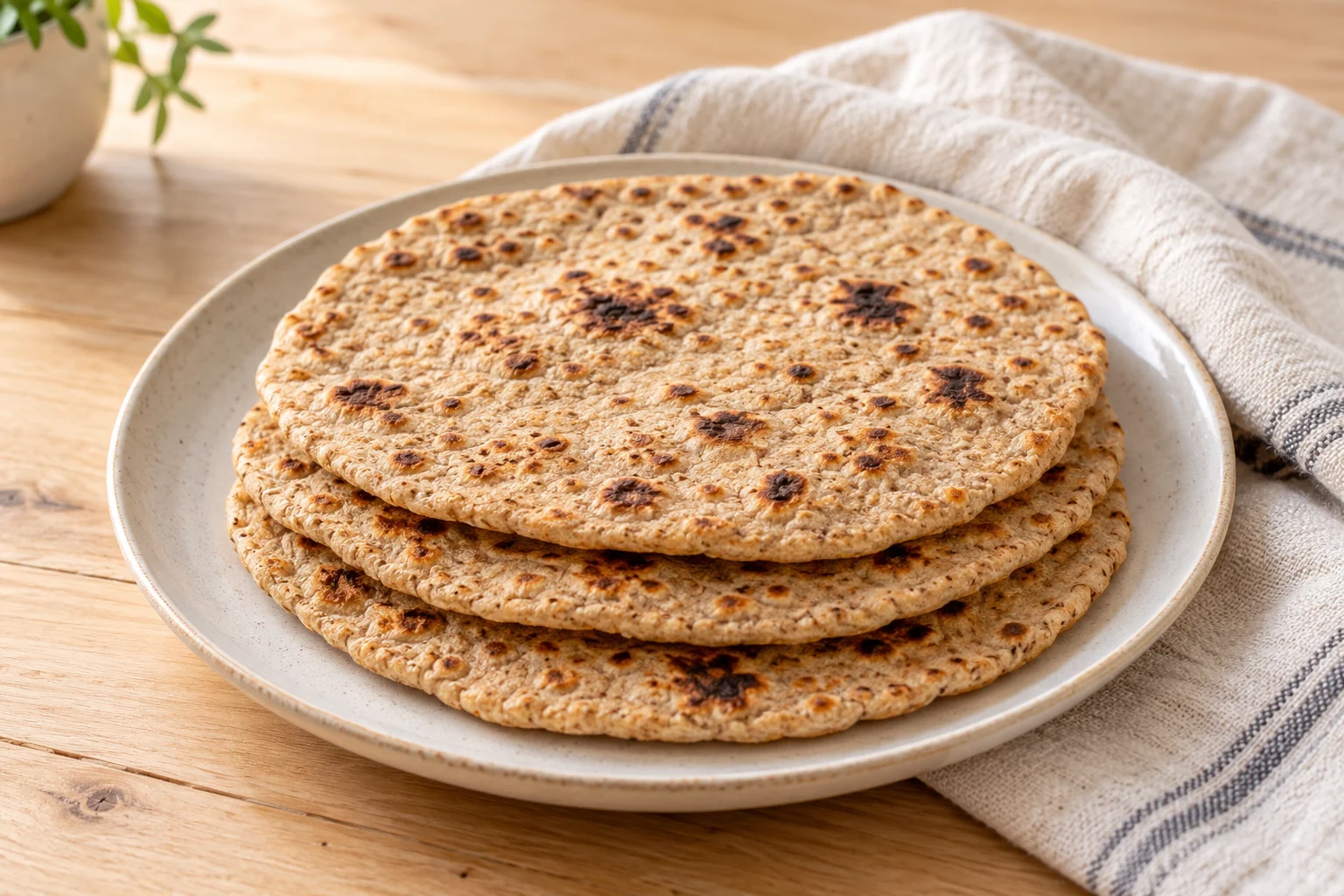
Soft, unleavened whole-wheat flatbreads made from flour, water, a little olive oil and salt, rolled thin and cooked one at a time in a dry skillet until spotted and puffed. Use them for wraps, dips or alongside soups.
- Prep
- 5 minutes
- Total time
- 70 minutes
- Portions
- 8
Estimated nutrition
| Nutrient | Per portion | Whole batch |
|---|---|---|
| Calories | 123 kcal | 983 kcal |
| Protein | 4.1 g | 33 g |
| Carbs | 22.5 g | 179.9 g |
| Fiber | 3.3 g | 26.8 g |
| Sugars | 0.1 g | 1 g |
| Added sugars | 0 g | 0 g |
| Fat | 2.7 g | 21.3 g |
| Saturated fat | 0.4 g | 3.1 g |
| Sodium | 98 mg | 787 mg |
| Cholesterol | 0 mg | 0 mg |
How these estimates work
Per portion and for your whole batch. These are ingredient-based estimates, not laboratory-tested nutrition facts. Optional ingredients are excluded.
Estimate includes all whole-wheat flour (dusting flour is assumed to end up on the breads; any left on the board makes the estimate slightly high), water, olive oil and salt, divided into eight flatbreads. Salt is modest. No sweetener is added. A bread component, not a meal.
USDA FoodData Central references. Brands, food varieties, preparation and portion size change the result. Added sugars assume plain, unsweetened ingredients; for prepared breads and sauces, a range shows zero to the reference food’s total sugar because the added amount is unspecified.
Ingredients, sources & assumptions
All listed edible food and oil are counted as eaten. Cooking losses and final cooked weight are not measured. Some ingredients use a stated reference food or a proxy for a missing nutrient. No personalized dietary advice.
Wheat flour, whole-grain (Includes foods for USDA's Food Distribution Program) · 250 g in the original batch
USDA food referenceSalt, table · 2 g in the original batch
USDA food referenceBeverages, water, tap, drinking · 165 g in the original batch
USDA food referenceOil, olive, salad or cooking · 15 g in the original batch
USDA food referenceCalculation version 2. Source records and method are documented in our nutrition guide.
Nutrition guidancePer portion and for your whole batch. These are ingredient-based estimates, not laboratory-tested nutrition facts. Optional ingredients are excluded.
Estimate includes all whole-wheat flour (dusting flour is assumed to end up on the breads; any left on the board makes the estimate slightly high), water, olive oil and salt, divided into eight flatbreads. Salt is modest. No sweetener is added. A bread component, not a meal.
USDA FoodData Central references. Brands, food varieties, preparation and portion size change the result. Added sugars assume plain, unsweetened ingredients; for prepared breads and sauces, a range shows zero to the reference food’s total sugar because the added amount is unspecified.
Let’s make it
Steps at a glance 5 steps
Amounts below match your selected batch. Follow each short step, and use timers as reminders to check the food.
Equipment
Kitchen scale · Mixing bowl · Rolling pin · Heavy skillet or griddle · Spatula · Clean kitchen towel
- 1
Mix and knead the dough
Wash hands and the work surface. Whisk 235 g whole-wheat flour with 2 g salt in a bowl. Add 165 ml warm water and 15 g olive oil and stir until shaggy, then knead in the bowl 5 to 6 minutes until smooth and soft; it should feel slightly tacky. Do not taste raw dough.
- 2
Rest the dough
Cover the bowl and rest the dough 20 minutes so the bran softens and the dough rolls out easily. Wash hands and anything that touched raw flour or dough.
- 3
Shape the rounds
Divide the dough into equal pieces, one per serving (eight for the base batch), and roll each into a ball. Using 15 g flour for dusting, roll each ball into a thin round about 15 cm across. Keep rolled rounds covered with a clean towel.
- 4
Cook until cooked through
Heat a heavy dry skillet over medium-high heat for about 3 minutes. Cook one round at a time for 1 to 2 minutes until bubbles appear and the underside has brown spots, flip, and cook 1 to 2 minutes more, pressing gently with a spatula to help it puff. Tear the first flatbread open: the center must look cooked and dry with no raw or gummy dough. If it is doughy, lower the heat slightly and cook each one longer.
- 5
Keep soft and store
Stack cooked flatbreads inside a clean towel so they steam and stay soft. Serve warm. Cool leftovers, then wrap and refrigerate within 2 hours of cooking.
My private recipe notes
Your notes don’t change this recipe’s dietary tags or nutrition.
How did this recipe turn out?
After trying it, share what you loved or help us make it better. You can change your vote anytime.
Loading community feedback…
Make it work for you
For kids & different preferences
Soft and slightly chewy once warm; tear into small strips suited to the child’s chewing skills. Children can help roll dough with clean hands under supervision, but must not taste raw dough and should wash hands afterward. Adults handle the hot skillet. Contains wheat. Not age-specific feeding guidance.
Storage & packed lunches
Wrap cooled flatbreads and refrigerate at 40°F / 4°C or colder within 2 hours of cooking (within 1 hour above 90°F / 32°C); use within 3 days. Keep any raw dough refrigerated and cook it the same day.
Freezing & reheating
Freeze cooled flatbreads separated by parchment in a sealed bag for up to 1 month. Reheat from frozen.
Warm in a dry skillet 30 to 60 seconds per side until hot and pliable throughout.
If something looks different
Stiff dough or cracked edges mean the flour absorbed more water than usual; rest the dough longer. Flatbreads that stay pale and hard were cooked too slowly; ones that scorch before the center cooks need lower heat. Always check the first one for a fully cooked center.
Something wrong with an ingredient or instruction? Tell us
Updated 2026-10-29
Bethany’s Kitchen · /recipes/whole-wheat-skillet-flatbreads · Original instructions and generated food illustration. Public culinary sources informed the combination; no third-party prose or photograph copied. Not physically kitchen-tested or human-reviewed.