Mediterranean-inspired · Easy
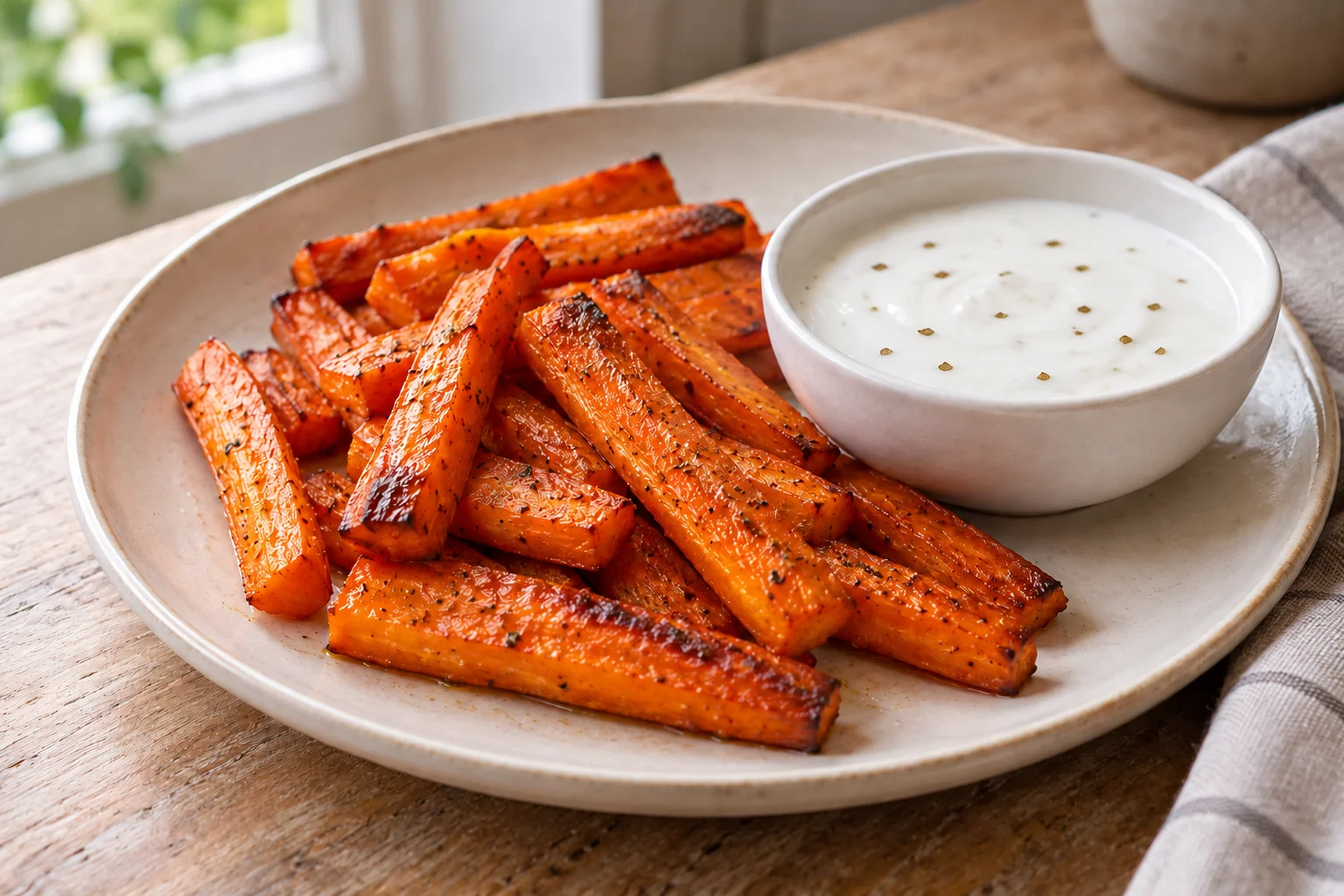
Roasted carrot batons with lemon-oregano yogurt dip
Tender roasted carrots with lightly browned edges meet a cool lemon-oregano yogurt dip. A vegetable-forward savory snack with a soft interior, not a deep-fried crunch.
- Prep
- 10 min
- Total time
- 50 min
- Portions
- 4
Estimated nutrition
| Nutrient | Per portion | Whole batch |
|---|---|---|
| Calories | 113 kcal | 454 kcal |
| Protein | 4.7 g | 18.7 g |
| Carbs | 17.2 g | 68.9 g |
| Fiber | 3.7 g | 15 g |
| Sugars | 10.7 g | 42.7 g |
| Added sugars | 0 g | 0 g |
| Fat | 3.4 g | 13.7 g |
| Saturated fat | 0.5 g | 2.1 g |
| Sodium | 230 mg | 918 mg |
| Cholesterol | 1 mg | 5 mg |
How these estimates work
Per portion and for your whole batch. These are ingredient-based estimates, not laboratory-tested nutrition facts. Optional ingredients are excluded.
Estimated nutrition uses raw, dry and drained weights, assumes all oil is eaten, and retains reference-food proxies and ranges. Actual brands, trimming and cooking losses vary. This is not laboratory analysis or a medical recommendation.
USDA FoodData Central references. Brands, food varieties, preparation and portion size change the result. Added sugars assume plain, unsweetened ingredients; for prepared breads and sauces, a range shows zero to the reference food’s total sugar because the added amount is unspecified.
Ingredients, sources & assumptions
All listed edible food and oil are counted as eaten. Cooking losses and final cooked weight are not measured. Some ingredients use a stated reference food or a proxy for a missing nutrient. No personalized dietary advice.
Carrots, raw · 500 g in the original batch
USDA food referenceYogurt, plain, skim milk · 240 g in the original batch
USDA food referenceLemons, raw, without peel · 20 g in the original batch
USDA food referenceOil, olive, salad or cooking · 12 g in the original batch
USDA food referenceSpices, oregano, dried · 1 g in the original batch
USDA food referenceSalt, table · 1 g in the original batch
USDA food referenceCalculation version 2. Source records and method are documented in our nutrition guide.
Nutrition guidancePer portion and for your whole batch. These are ingredient-based estimates, not laboratory-tested nutrition facts. Optional ingredients are excluded.
Estimated nutrition uses raw, dry and drained weights, assumes all oil is eaten, and retains reference-food proxies and ranges. Actual brands, trimming and cooking losses vary. This is not laboratory analysis or a medical recommendation.
USDA FoodData Central references. Brands, food varieties, preparation and portion size change the result. Added sugars assume plain, unsweetened ingredients; for prepared breads and sauces, a range shows zero to the reference food’s total sugar because the added amount is unspecified.
Let’s make it
Steps at a glance 5 steps
Amounts below match your selected batch. Follow each short step, and use timers as reminders to check the food.
Equipment
Kitchen scale · Knife · Cutting board · Bowl · Large baking tray · Baking parchment rated for the oven temperature · Oven · Spatula
- 1
Prepare the carrots
Heat the oven to 425°F / 220°C. Wash and trim 500 g (about 8 medium carrots, trimmed) carrots, weighing the edible amount, then cut into even batons about one centimeter thick and five centimeters long. Toss with 12 g olive oil, 0.75 g salt and 0.5 g dried oregano. Spread in one layer on a lined baking tray with space between pieces.
- 2
Roast, then turn the carrots
Roast for 15 minutes, starting this timer when the tray enters the oven. Turn the batons with a spatula; they are not finished at this point. Use extra trays for larger batches so pieces stay in a single layer.
- 3
Finish roasting and check tenderness
After turning, roast for another 10–20 minutes, for 25–35 minutes total. Start this separate timer after turning. Check that every baton is easily pierced through the center; cook longer if needed. The carrots should be tender with lightly browned edges, not crisp like deep-fried potatoes. For a child who needs soft textures, check that the carrot can be mashed easily before serving.
- 4
Mix the cool dip
Wash the lemon before peeling and cutting. While the carrots roast, stir 240 g plain unsweetened yogurt with 20 g finely chopped lemon flesh and its juice, 0.5 g oregano and 0.25 g salt. Keep covered in the refrigerator until serving. This uses ordinary nonfat yogurt, so expect a smooth stirred dip whose thickness varies by brand.
- 5
Portion and serve
Let the carrots cool to a comfortable eating temperature. Divide all carrots and dip equally among the selected snack portions. Keep the dip separate until eating.
My private recipe notes
Your notes don’t change this recipe’s dietary tags or nutrition.
How did this recipe turn out?
After trying it, share what you loved or help us make it better. You can change your vote anytime.
Loading community feedback…
Make it work for you
For kids & different preferences
Adults use knives and handle the hot oven and tray. Cook carrots until soft enough to mash, then cut or mash further for the child’s texture skills; do not offer hard raw carrot sticks. Check milk allergy. Seat children upright and supervise eating. This is not infant-feeding guidance or suitable for every age.
Storage & packed lunches
Refrigerate in shallow covered containers at 40°F / 4°C or colder within 2 hours, or within 1 hour above 90°F / 32°C. Use within 3 days. Pack cold with ice packs when taking along.
Freezing & reheating
Freeze cooked carrots alone for up to 1 month for quality; they soften after thawing. Make the yogurt dip fresh.
Reheat cooked carrots to 165°F / 74°C throughout. Keep the yogurt dip cold and separate.
If something looks different
Cooking times are guides. Check texture and temperature; larger batches need extra pan space and may take longer.
Something wrong with an ingredient or instruction? Tell us
Updated 2026-10-28
Bethany’s Kitchen · /recipes/roasted-carrot-batons-yogurt-dip · Original instructions and generated food illustration. Public culinary sources informed the combination; no third-party prose or photograph copied. Not physically kitchen-tested or human-reviewed.